Most articles about how to start investing with $100 repeat the same generic advice, but understanding how to start investing with $100 the right way means grasping the actual mechanics behind why small, consistent investments work, or what specifically trips up beginners in practice . This guide goes deeper: real numbers, real platform considerations, and the reasoning behind each step.
How to Start Investing with $100: Why the Starting Amount Matters Less Than People Think
The fintech shift over the past decade genuinely removed old barriers: minimum investment requirements that used to sit at $1,000-$3,000 for many funds have largely disappeared, replaced by fractional share investing and zero-commission trading apps. But there’s a nuance rarely explained: the real barrier was never the dollar amount — it was the habit of investing regularly. A person who invests $100 once and stops has built almost nothing. A person who commits to $100 monthly for 20 years has built something substantial, purely because of consistency, not the starting figure.
Step 1: The Emergency Fund Isn’t Optional — Here’s the Real Reason Why
The advice to build a $500-$1,000 emergency fund before investing isn’t arbitrary caution — it directly protects your investment returns. Here’s the mechanism: markets don’t move in a straight line. If an unexpected expense forces you to sell investments during a temporary market dip (which happens regularly, not rarely), you convert a paper loss into a real, locked-in loss. An emergency fund breaks this chain entirely by giving you a separate pool of cash for emergencies, so your investments stay untouched through market volatility.
Practical detail often skipped: keep this fund in a high-yield savings account, not invested in stocks or funds — it needs to be accessible instantly without any risk of loss when you need it. If you haven’t built this safety net yet, our emergency fund guide walks through exactly how to do it before you take Step 1 here.
Step 2: Choosing Your Account Type — The Real Trade-Off Explained
Brokerage account: No restrictions on withdrawals, no tax advantages upfront, but full flexibility. This is genuinely the right starting point for most beginners with $100, because retirement accounts often come with rules (contribution limits, withdrawal penalties before a certain age) that add complexity you don’t need on day one.
Retirement accounts (401k, IRA, or regional equivalents): These offer real tax advantages, but the withdrawal restrictions mean your money is effectively locked until a much later date. The mistake many beginners make is opening a retirement account first without understanding these restrictions, then needing that money years before they can access it penalty-free.
Practical recommendation: Start with a basic brokerage account for your first $100-$500, and only consider retirement-specific accounts once you have a stable, predictable amount you can commit to it long-term without needing early access.
Step 3: Investment Options for Beginners — What Actually Differs Between Them
Index Funds track an entire market benchmark (like a broad stock market index), meaning your $100 is instantly spread across hundreds of companies rather than concentrated in one. The real advantage here isn’t just “low fees” as a slogan — it’s that historically, the vast majority of actively managed funds fail to beat simple index funds over long periods, after accounting for their higher fees. This makes index funds a mathematically sound default choice for beginners, not just a “safe” one.
ETFs (Exchange-Traded Funds) function similarly to index funds in terms of diversification, but trade throughout the day like individual stocks, rather than being priced once at market close like traditional mutual funds. For a beginner with $100, this distinction rarely matters in practice — the diversification benefit is what counts most, not the trading mechanics. Our ETFs for beginners guide covers this in far more depth if you want to understand the mechanics fully.
Fractional Shares solve a specific problem: expensive individual stocks (priced at hundreds or thousands of dollars per share) become accessible with small amounts. The important caveat: buying fractional shares of a single expensive company still concentrates your risk in that one company. Fractional shares are best used to build a diversified basket of several companies gradually, not as a shortcut to owning “just one exciting stock.”
Step 4: Platform Selection — Criteria That Actually Matter
Beyond the standard checklist (no minimums, fractional shares, low fees), two often-overlooked factors matter significantly for beginners:
Regulatory oversight in your actual country of residence. Not every popular platform accepts residents from every country, and some platforms marketed heavily online simply aren’t available where you live. Always verify direct availability on the platform’s official site before spending time on signup, rather than assuming based on general popularity.
Quality of educational resources within the app itself. Platforms that explain what you’re buying, in plain language, directly within the investing flow, tend to reduce panic-driven mistakes later — because you understand what you own and why, not just that a chart is moving up or down.
Step 5: Automatic Investing and Why It Works Psychologically, Not Just Financially
Dollar-Cost Averaging (investing a fixed amount on a fixed schedule, regardless of price) works for a reason beyond simple mathematics: it removes the emotional decision-making that causes most investor losses. When investing is automated, you’re not deciding weekly whether “now is a good time” — a decision that research consistently shows most people, including professionals, get wrong more often than chance would predict.
Concrete example: automating $50 biweekly means you buy more shares when prices are low and fewer when prices are high, averaging your purchase cost over time without needing to predict market movements at all.
Common Mistakes When Investing with a Small Amount — The Reasoning Behind Each One
Trying to time the market perfectly: Even professional fund managers with full-time teams and data access consistently fail to time markets reliably over long periods. A beginner attempting this with less information and more emotional investment in the outcome faces even worse odds.
Investing money needed soon: This directly connects back to Step 1 — without a separate emergency fund, “soon-needed money invested in the market” becomes a forced sale at whatever price happens to exist that day, good or bad.
Concentrating in one stock: A single company can underperform or fail entirely for reasons unrelated to the broader market (management issues, industry disruption, regulatory problems). Diversification specifically protects against this company-specific risk, which index funds and ETFs are structurally designed to minimize.
Checking your portfolio daily: This isn’t just a stress-management tip — frequent checking measurably correlates with more emotional trading decisions, because daily price movements are mostly noise, not meaningful signal, especially for long-term investors.
Panic selling during downturns: Historically, market downturns have been followed by recoveries over sufficiently long time horizons. Selling during a downturn locks in the loss permanently and removes any chance of participating in the eventual recovery.
How to Start Investing with $100: What Your Money Can Actually Grow Into
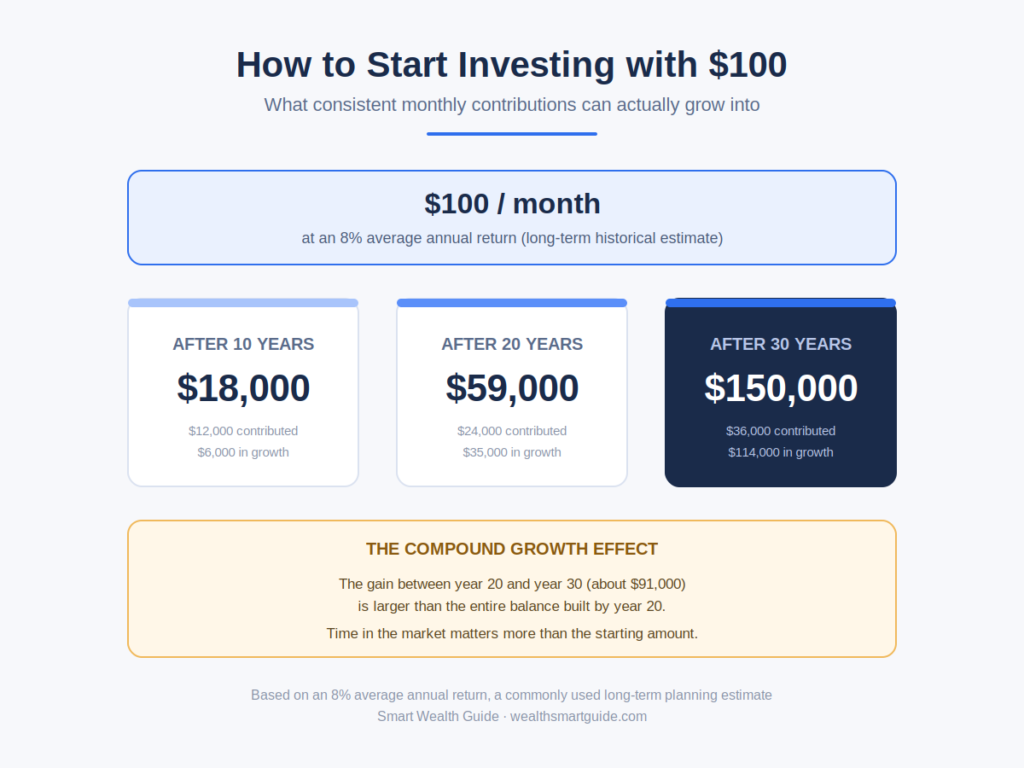
This is the core question behind how to start investing with $100 — With consistent monthly contributions of $100 and an average annual return of 8% (a commonly used long-term historical estimate for diversified stock investments, per historical S&P 500 return data, though not guaranteed):
- After 10 years: approximately $18,000
- After 20 years: approximately $59,000
- After 30 years: approximately $150,000
The mechanism worth understanding, not just the numbers: notice that the growth between year 20 and year 30 (roughly $91,000 in gains) is larger than the total accumulated by year 20 itself. This isn’t a coincidence — it’s compound interest accelerating over time, because you’re earning returns not just on your contributions, but on all the previously accumulated returns as well. This is precisely why starting early matters more than starting with a larger amount later.
Conclusion: How to Start Investing with $100 the Right Way
You don’t need significant wealth to start investing — you need a clear system: an emergency fund first, a simple brokerage account, diversified low-cost funds, automated consistent contributions, and genuine patience through market fluctuations. The mathematics of compound growth rewards time in the market far more than it rewards perfect timing or a larger starting amount. Open an account today, even with just $100, and let consistency do the rest of the work over the years ahead.