Most ETF explanations present the concept correctly but skip the nuance that actually helps beginners avoid costly mistakes: what “average return” really means in practice, why certain popular ETFs carry meaningfully different risk profiles despite looking similar on the surface, and the specific mechanics that make ETFs structurally different from actively managed funds.
What Is an ETF? A Mechanical Explanation for Beginners
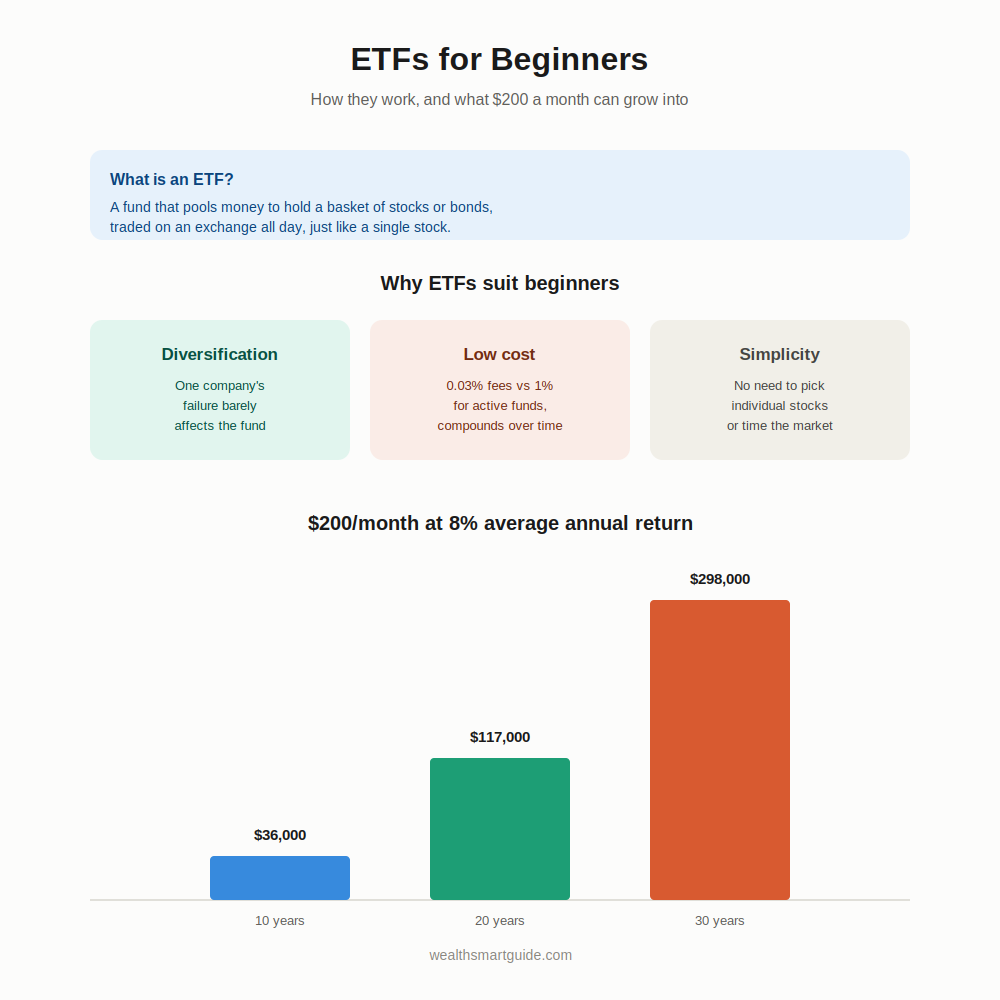
An ETF (Exchange-Traded Fund) pools money from many investors to hold a basket of assets — typically stocks, but sometimes bonds or other securities — and divides ownership of that basket into shares that trade on an exchange throughout the day, just like individual stocks. When you buy one share of an S&P 500 ETF, you’re not buying a tiny piece of every one of those 500 companies directly in a legal sense — you’re buying a share of the fund itself, which in turn holds those underlying stocks. This structural distinction matters mainly for understanding how ETFs differ from mutual funds: ETFs can be bought or sold at any point during market hours at a live price, while traditional mutual funds are priced only once per day after markets close.
Why ETFs Suit Beginners: The Reasoning Behind Each Advantage
Instant diversification, and why it specifically protects you: if you owned a single company’s stock and that company faced a major scandal, lawsuit, or industry disruption, your entire investment could lose significant value overnight. An ETF holding hundreds of companies means one company’s failure gets diluted across the entire basket — a single struggling company among 500 has a proportionally tiny effect on the fund’s overall value.
Low cost, and why the fee difference compounds over decades: an actively managed fund charging 1% annually versus an ETF charging 0.03% might sound like a trivial difference on a single year’s statement, but compounded over 30 years, that fee gap alone can consume tens of thousands of dollars in what would otherwise have been investment growth. Fees are deducted regardless of whether the fund performs well or poorly, making them one of the few variables an investor can control with certainty.
No stock-picking research required, but this has a limit worth understanding: buying a broad market ETF means you don’t need to analyze individual company financials, but you still benefit from understanding what index the ETF actually tracks, since different ETFs carry meaningfully different risk and concentration levels, as explained below.
Historical Returns: The Number Everyone Cites, and the Nuance Usually Left Out
The S&P 500 has indeed returned close to 10% annually on average over multi-decade periods (some measurement periods show slightly above 10%, others closer to 9-11% depending on the exact start and end dates used). What’s critical to understand, and frequently omitted: this average conceals enormous year-to-year variation. Some years the index returns 25-30%; other years it loses 20% or more. Over a 50-year sample, actual annual returns landed close to that average figure in only a small handful of individual years — most years were meaningfully above or meaningfully below it. Historical S&P 500 return data is publicly tracked and widely cited by sources like Macrotrends.
Why this matters practically: a beginner expecting a smooth, predictable 10% every single year will be caught off guard by a down year and may panic-sell at exactly the wrong moment. Understanding that the 10% figure is a long-term average built from a wide spread of very different individual years — not a guaranteed annual outcome — is essential for staying invested through the inevitable rough years.
Popular Beginner ETFs — What Actually Differs Between Them, Beyond the Ticker
S&P 500 ETFs (tracking the 500 largest US companies): the most broadly diversified option among the “large-cap” category, though still concentrated specifically in large US companies, not the entire global economy.
Nasdaq 100 ETFs (tech-heavy): these carry meaningfully higher volatility than broad S&P 500 ETFs, because they concentrate heavily in the technology sector specifically. Historically, this has meant higher growth potential during tech sector booms, but also sharper declines during tech-specific downturns — a beginner choosing this option should understand they’re accepting sector concentration, not just “a slightly more aggressive version” of a broad market fund.
Total US stock market ETFs: these extend beyond the largest 500 companies to include mid-size and smaller US companies as well, offering marginally broader diversification than S&P 500-only funds, though the largest companies still dominate the fund’s overall weighting in practice.
Total world ETFs: these add international company exposure on top of US companies, which matters specifically for reducing dependence on the US economy’s performance alone — a genuine diversification benefit that purely domestic funds cannot provide, though historically the US market has often outperformed international markets over the past several decades (a pattern that isn’t guaranteed to continue indefinitely).
ETFs for Beginners: Practical Steps to Start Investing
Step 1: Open a brokerage account with a platform that genuinely operates and is regulated in your country of residence — verify this directly rather than assuming based on a platform’s general global popularity.
Step 2: Fund your account with whatever amount you’re comfortable committing regularly, even if modest — the consistency of ongoing contributions matters more than the size of the first deposit.
Step 3: Identify the specific index an ETF tracks before buying it, not just its popularity or ticker recognition. Two ETFs that sound similar can carry very different underlying concentration and risk levels, as detailed above.
Step 4: Place your first purchase, understanding that ETF prices fluctuate throughout the trading day just like individual stocks — there’s no need to try to time the “perfect” moment within a trading session for a long-term investment.
Step 5: Automate future contributions on a fixed schedule, which removes the emotional guesswork of deciding when to invest and naturally applies dollar-cost averaging over time.
ETFs vs Individual Stocks — The Trade-Off in Plain Terms
ETFs trade the potential for outsized gains from a single winning company for structurally lower risk through automatic diversification. Individual stocks require ongoing company-specific research and carry meaningfully higher risk of significant loss if that single company underperforms, but also carry the theoretical potential for returns well above the broad market average if you happen to pick a future top performer — something that even professional fund managers struggle to do consistently over long periods.
How Much Can $200 Monthly in ETFs Actually Grow Into?
With consistent monthly contributions of $200 and an average annual return of 8% (a commonly used long-term planning estimate, deliberately somewhat conservative relative to the historical S&P 500 average discussed above, to account for fees and return variability):
- After 10 years: approximately $36,000
- After 20 years: approximately $117,000
- After 30 years: approximately $298,000
The mechanism worth noting again: the growth between year 20 and year 30 (roughly $181,000) is significantly larger than the total accumulated through year 20 alone. This acceleration is compound growth at work — a mathematical reason why starting early, even with a modest monthly amount, tends to outperform starting later with a larger amount, purely due to additional years of compounding. This same compounding principle applies whether you’re investing in ETFs or building your emergency fund — consistency matters more than the starting amount.
Common ETF Mistakes — The Reasoning Behind Each
Panic selling during downturns: given the significant year-to-year variance explained earlier, a down year is a statistically normal part of long-term investing, not a signal that something has gone wrong with your strategy.
Checking your portfolio daily: daily price movements are largely short-term noise; frequent checking correlates strongly with emotionally-driven decisions that undermine long-term strategy.
Investing money needed in the short term: given normal market volatility, funds you’ll need within the next few years shouldn’t be exposed to the risk of a poorly-timed downturn forcing a loss-locking sale.
Chasing the latest popular ETF without understanding what it holds: as shown above, ETFs that sound similar can carry very different concentration and risk profiles — understanding the underlying index matters more than following current trends.
Not reinvesting dividends: many ETFs distribute periodic dividend payments; automatically reinvesting these (rather than withdrawing them as cash) meaningfully accelerates long-term compound growth, since those dividends then also generate their own future returns.
Conclusion: ETFs for Beginners, Summed Up
ETFs for beginners offer genuine structural advantages — low cost, automatic diversification, and simplicity — but understanding the real variance behind headline average returns, and the meaningful differences between ETFs that appear superficially similar, separates investors who stay the course through inevitable down years from those who panic-sell at the worst possible moments. Start with a broad, low-cost ETF matching your understanding of its actual risk level, invest consistently every month, and let compound growth do the work over years, not weeks.— that’s the real lesson for ETFs for beginners.