Most explanations of the 50/30/20 rule stop at listing the three categories without explaining why this specific split works, what to do when your situation doesn’t fit neatly into it, or the psychological reasons budgets typically fail. This guide covers all of that in depth.
Why This Specific Split, and Not Some Other Ratio?
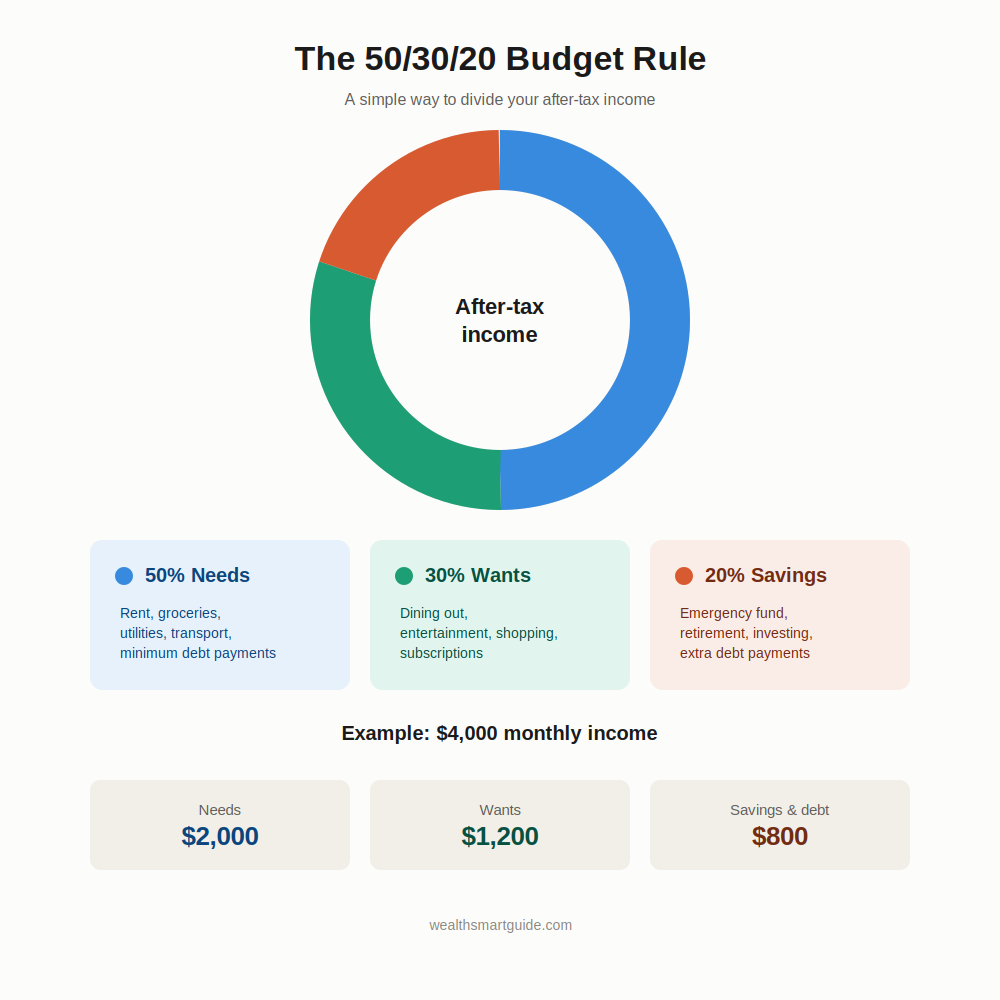
The 50/30/20 rule isn’t an arbitrary convention — it’s built around a practical insight: rigid, overly restrictive budgets fail more often than flexible ones, because people abandon systems that feel punishing. By allowing a full 30% for genuine wants (not just survival needs), this method acknowledges that sustainable budgeting requires room for enjoyment, not just discipline. A budget that allocates 90% to needs and savings with zero flexibility tends to collapse within a few months as people quietly abandon it out of frustration. This approach is widely recognized as one of the simplest budgeting frameworks for beginners.
Needs (50%) in the 50/30/20 Rule — Where the Line Gets Blurry
The tricky part of this category isn’t identifying obvious needs like rent or utilities — it’s correctly classifying expenses that feel essential but aren’t strictly necessary. A $15 monthly streaming subscription isn’t a “need” even if it feels routine. A $300 gym membership isn’t a need unless it’s genuinely tied to a documented health requirement.
Practical test for classification: ask whether you would keep paying for this expense if your income dropped by 30% tomorrow. If the honest answer is “probably not, but I’d try to keep it,” it belongs in Wants, not Needs — regardless of how routine it currently feels.
When needs exceed 50% — a common real-world problem the basic rule doesn’t fully address: in many high cost-of-living areas, housing alone can consume 40-50% of income before any other need is counted. In this case, the goal isn’t to force an unrealistic 50% ceiling immediately, but to treat reducing this specific cost (through relocation, a roommate, or renegotiating rent) as a distinct, longer-term project running in parallel with the rest of the budget.
Wants (30%) in the 50/30/20 Rule — Where Most Budgets Go Wrong
This is where most budget tracking fails silently. People consciously notice big want-expenses (a vacation, a major purchase) but consistently underestimate the cumulative effect of small, frequent ones: daily coffee, small food delivery orders, impulse online purchases under $20 each.
Why this matters mathematically: five small $8 purchases per week ($40 weekly) add up to roughly $173 monthly — often enough to single-handedly break a want budget that looked comfortable on paper. Tracking only large, memorable purchases while ignoring small recurring ones is the single most common reason people believe they’re “following” the 50/30/20 rule while actually overspending in this category by a significant margin.
Category 3: Savings and Debt (20%) — Why This Isn’t Just “Leftover Money”
The framing matters enormously here: this 20% should be treated as a fixed, non-negotiable line item — deducted immediately upon receiving income, not calculated from whatever happens to remain at month’s end. Treating savings as “whatever’s left over” is precisely why most people who attempt budgeting without this reframing end up saving inconsistently or not at all, even with good intentions.
A distinction worth making explicit: within this 20%, prioritize any high-interest debt (typically anything above roughly 15-20% annual interest) before general investing. Mathematically, guaranteed debt interest savings usually outweigh uncertain investment returns, meaning aggressive debt paydown often deserves priority within this category before allocating heavily toward long-term investment contributions.
Detailed Example: $4,000 Monthly Income, With the Reasoning Behind Each Allocation
Needs (50%): $2,000
- Rent: $1,200 — the single largest line item, worth revisiting periodically if it consistently strains the budget
- Groceries: $400 — note this is groceries specifically, not dining out, which belongs in Wants
- Utilities: $200
- Transportation: $200
Wants (30%): $1,200
- Dining out: $400
- Entertainment: $300
- Shopping: $300
- Subscriptions: $200 — worth auditing every few months, as forgotten subscriptions are one of the most common silent budget leaks
Savings and Debt (20%): $800
- Emergency fund: $300 (until it reaches 3-6 months of expenses, then redirect this portion)
- Retirement/investment account: $300
- Extra debt payment: $200 (beyond any minimum already counted in Needs)
Applying the Rule Step by Step, With the Detail Usually Skipped
50/30/20 Budget Calculator
Step 1: Calculate after-tax income accurately. Use your actual take-home pay, not gross salary — a mistake that throws off every subsequent calculation if made incorrectly at this first step.
Step 2: Track every expense for a full month before categorizing anything. Attempting to categorize from memory alone consistently underestimates real spending, particularly in the Wants category, for the reasons explained above.
Step 3: Categorize honestly, using the “would I keep it at 30% less income” test described earlier for ambiguous cases.
Step 4: Compare current spending to target percentages, and identify the single largest gap first, rather than trying to fix every category simultaneously.
Step 5: Adjust gradually over 2-3 months, not immediately. Attempting an overnight jump from, say, 5% savings to a full 20% savings rate typically triggers the same abandonment problem discussed earlier — incremental adjustment (moving 3-5 percentage points per month) tends to stick significantly better long-term.
If You Can’t Hit These Numbers Yet — A Realistic Path Forward
If needs currently consume 70% of income, the honest priority isn’t forcing an immediate fit into the 50/30/20 structure — it’s identifying whether this is a temporary situation (recent job loss, short-term expense spike) or a structural one (housing costs genuinely too high relative to income in your area). Structural situations require a longer-term plan (income growth, relocation, debt restructuring) running alongside a modified, temporary budget ratio, rather than treating the standard percentages as an immediate, rigid requirement.
The consistency principle worth emphasizing: saving even 5% reliably every month compounds meaningfully over years, while an unstarted “perfect” 20% budget plan produces exactly zero savings for as long as it remains unstarted. The imperfect but consistent approach mathematically outperforms the perfect but delayed one.
Tools: Choosing Based on Actual Follow-Through, Not Feature Lists
The genuinely important criterion isn’t which tool has the most features — it’s which one you’ll actually open and update weekly. A simple spreadsheet updated consistently produces far better real-world results than a sophisticated budgeting app abandoned after two weeks. Start with the simplest tool that matches your existing habits (a notebook if you already write things down regularly, a spreadsheet if you’re comfortable with basic formulas), and only add complexity if the simple version genuinely proves insufficient after a few months of honest use.
Common Mistakes — Why Each One Specifically Derails Budgets
Forgetting irregular expenses (car repairs, annual insurance renewals, holiday gifts): these don’t disappear just because they’re infrequent — divide their annual estimated cost by 12 and build that average into your monthly Needs or Wants allocation, rather than treating them as unplanned surprises each time they occur.
Not tracking small daily purchases: as shown mathematically above, this category alone often explains the entire gap between a budget that looks correct on paper and actual bank balances at month’s end.
Setting unrealistic restriction levels: a budget that eliminates all discretionary spending typically fails within weeks, not because of weak willpower, but because it’s structurally designed to be abandoned — sustainable systems build in intentional flexibility.
Giving up after one difficult month: a single month exceeding targets (due to an emergency or unusual expense) doesn’t invalidate the system — it’s a single data point, not evidence that the approach doesn’t work.
Not adjusting as income changes: a budget calculated once and never revisited becomes increasingly inaccurate as raises, job changes, or new expenses occur — a brief monthly or quarterly review keeps the percentages meaningfully aligned with reality.
Conclusion
The 50/30/20 rule works not because the specific percentages are mathematically sacred, but because it provides a simple, flexible structure that most people can actually sustain long-term, unlike overly rigid alternatives. The real work lies in honest expense tracking (especially small recurring purchases), gradual adjustment rather than overnight change, and treating savings as a fixed obligation rather than leftover money. Start applying it this month imperfectly, and refine the details as you learn your actual spending patterns over the following months.