If you’re wondering how to build an emergency fund, most guides repeat the “3 to 6 months” rule without explaining why that specific range exists, how to determine where you personally fall within it, or the psychological reasons people struggle to actually build one despite understanding its importance. This guide addresses all three gaps.
What an Emergency Fund Actually Protects You From — The Mechanism, Not Just the Definition
An emergency fund’s real function isn’t simply “having money for surprises” — it’s breaking a specific, damaging financial chain: without one, an unexpected expense forces you into one of two costly options: high-interest debt (credit cards, payday loans) or selling investments at whatever price happens to exist that day, even during a market downturn. An emergency fund exists specifically to interrupt this chain, keeping both your credit and your long-term investments untouched by short-term emergencies.
This is precisely why an emergency fund isn’t for planned or discretionary expenses — vacations and shopping don’t create the same forced, urgent decision under pressure that job loss or a medical emergency does.
How Much You Actually Need: Why the Range Varies, Not Just What the Range Is
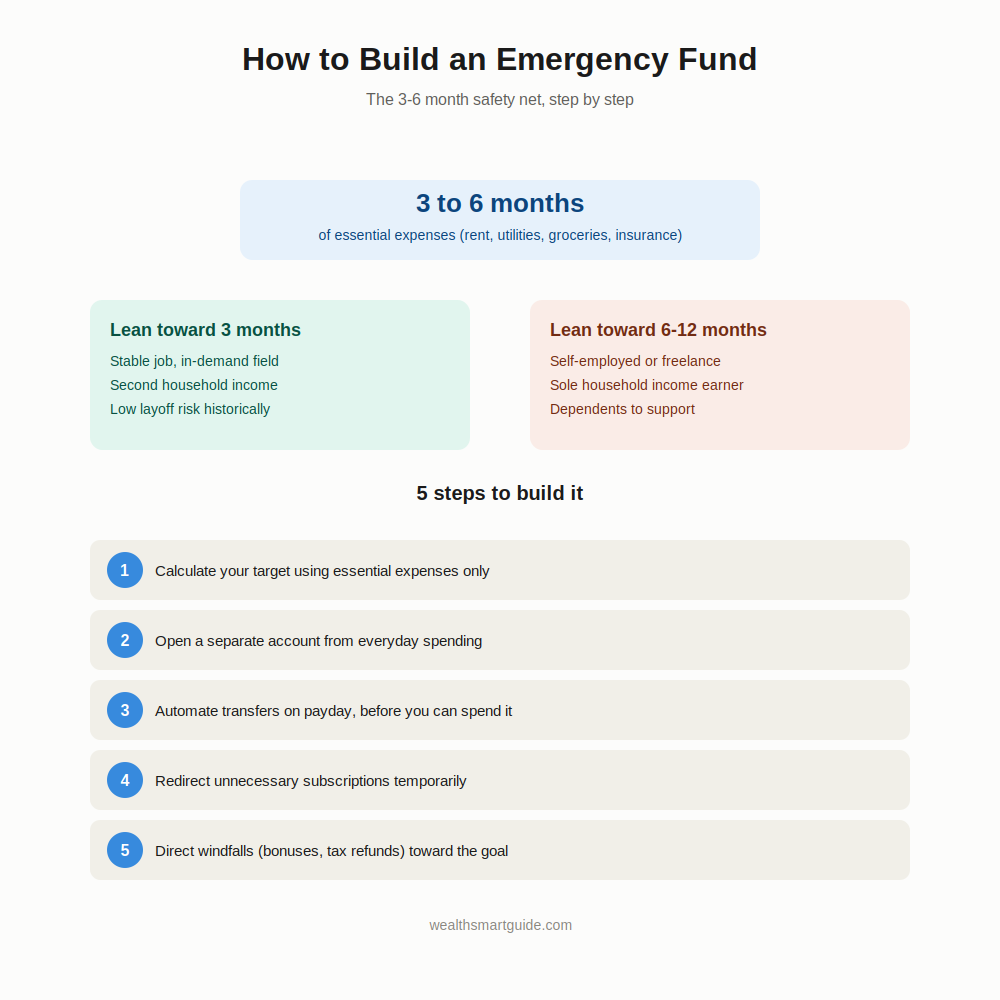
The standard 3-6 month recommendation isn’t one-size-fits-all, and understanding why helps you pick the right target for your specific situation, rather than defaulting to a generic middle number.
Factors that push you toward 3 months (the lower end):
- Stable employment in an in-demand field where re-employment would likely be fast
- A second income in the household providing a backup
- Strong job security with low layoff risk historically in your industry
Factors that push you toward 6-12 months (the higher end):
- Self-employment or freelance income, where income itself is inherently variable month to month
- Being the sole income earner in your household
- Working in an industry with historically higher volatility or longer average job-search periods
- Having dependents whose expenses can’t be easily reduced during a financial gap
Practical calculation example: if your essential monthly expenses (not total spending — specifically rent, utilities, groceries, insurance, minimum debt payments) total $2,000, your target range is $6,000-$12,000. This is exactly the kind of goal that fits naturally into the Savings and Debt portion of the 50/30/20 rule, which is one practical way to structure how you build an emergency fund alongside your other financial goals. The specific number within that range should reflect which of the factors above apply most strongly to your situation, not simply picking the midpoint by default.
Where to Keep It: The Reasoning Behind Each Requirement
Why liquidity matters specifically: an emergency, by definition, arrives without advance notice. Money locked in a fixed-term deposit or investment that takes days or weeks to access defeats the purpose — the fund needs to be reachable within at most a day or two, ideally instantly via transfer.
Why market-based investments are specifically wrong for this money: the exact scenario an emergency fund protects against — job loss during an economic downturn — statistically correlates with periods when markets are also more likely to be down. This means the worst possible moment to need this money is often also the worst possible moment to be forced to sell investments, locking in losses precisely when you can least afford them. This correlation is the specific, concrete reason this rule exists, not just general caution.
Why “earning some interest” is a secondary consideration, not the primary goal: a high-yield savings account earning a modest, safe return is preferable to chasing a slightly higher return through a riskier vehicle. The entire purpose of this money is safety and immediate access — any yield earned is a welcome bonus, never the primary objective. This is why high-yield savings accounts are widely recommended as the ideal place to keep this money.
How to Build an Emergency Fund: A Realistic Step-by-Step Approach
Step 1: Calculate your specific target using actual essential expenses, not your full current spending level, which likely includes discretionary items you could reduce during a real emergency if needed.
Step 2: Physically separate this account from your everyday spending account. This isn’t just organizational preference — behavioral finance research consistently shows that money sitting in the same account as regular spending gets spent, even with the best intentions, simply because it’s visible and accessible during unrelated purchase decisions.
Step 3: Automate transfers on payday, before you see the money as available to spend. This directly parallels the reasoning behind treating savings as a fixed obligation rather than leftover money, discussed in budgeting contexts — money automated away before it reaches your spending account is dramatically more likely to actually accumulate than money you intend to transfer manually “when you remember.”
Step 4: Identify genuinely unnecessary recurring expenses to redirect temporarily, specifically forgotten subscriptions and frequent small discretionary purchases — not permanent lifestyle sacrifices, but temporary redirections until the fund reaches its target.
Step 5: Direct windfalls entirely toward this goal until fully funded. Tax refunds, work bonuses, and cash gifts represent money you weren’t relying on for regular expenses, making them ideal candidates for accelerating a goal that would otherwise take months of incremental saving to reach.
Realistic Timelines: What the Numbers Actually Show
Saving $200 monthly toward a $3,000 target (roughly 3 months of $1,000 expenses) takes approximately 15 months; the same monthly amount toward $6,000 takes roughly 30 months. Saving $500 monthly cuts these timelines to roughly 6 and 12 months respectively.
The practical takeaway from these numbers: the fastest way to shorten your timeline isn’t waiting for a larger lump sum to appear — it’s identifying whichever specific spending category, once reduced, most directly increases your monthly automated transfer, even temporarily during the building phase.
Distinguishing True Emergencies from Emergency-Fund Temptation
The clearest practical test: is this expense both unexpected and necessary? A car repair needed to get to work satisfies both conditions. A sale on a favorite store, however tempting or time-limited it feels, satisfies neither — it was neither unexpected (sales are a predictable, recurring marketing event) nor necessary.
A genuinely useful mental habit: before withdrawing from this fund, explicitly ask whether you could have reasonably predicted this expense a month in advance. If yes, it likely belongs in your regular discretionary budget planning, not this fund — and dipping into the fund for it undermines the entire safety net for the genuine emergency that will eventually arrive.
Conclusion
Now that you know how to build an emergency fund, remember: it isn’t a nice-to-have addition to a financial plan — it’s the specific mechanism that prevents a temporary setback (job loss, medical bill, urgent repair) from becoming a lasting financial disaster through forced debt or poorly-timed investment sales. Calculate your target based on your actual job stability and income structure, keep the money liquid and separate from both spending and investing, and automate contributions so the habit builds independent of willpower alone. Start today, even with a small amount — the automated habit matters more in the early months than the total accumulated so far.