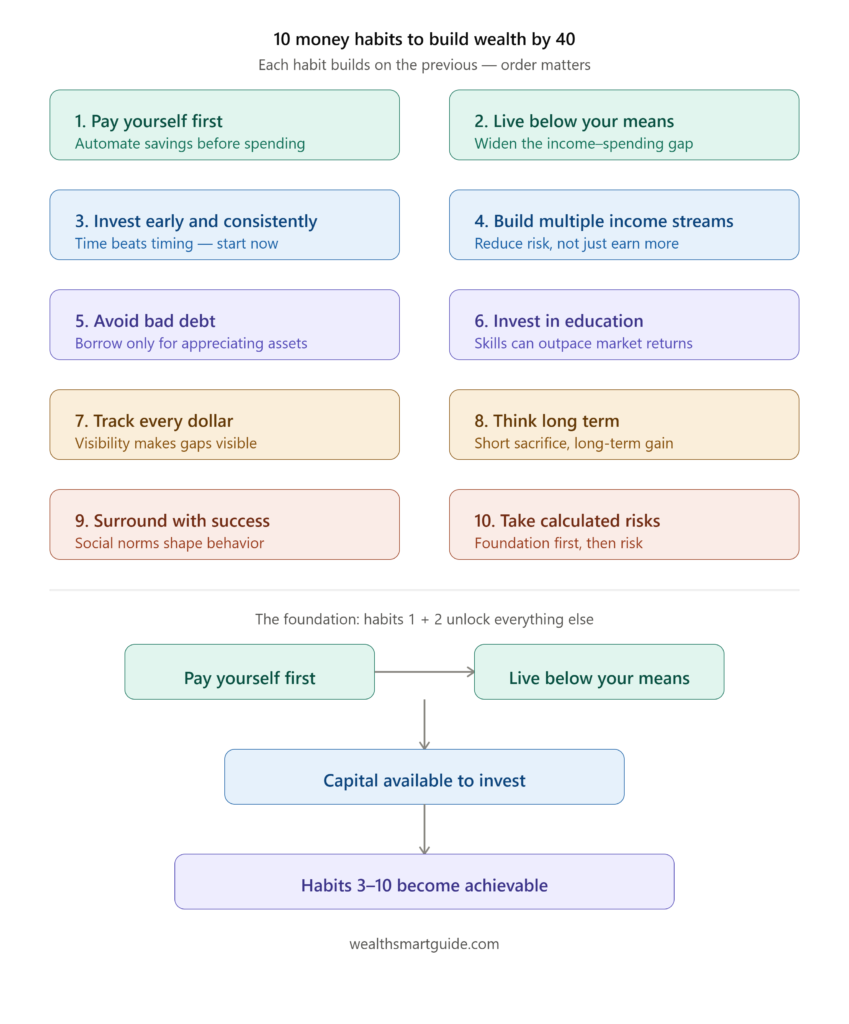
Most “money habits to build wealth” articles list these ten points as if they carry equal weight and operate independently. In reality, they connect in a specific logical sequence, and understanding that sequence — which habits enable others, and why certain ones matter more early versus later — makes this list far more actionable than a simple checklist. After reviewing the financial patterns of people who successfully built wealth over decades, one pattern stood out consistently: the order in which these habits are adopted matters almost as much as the habits themselves.
1. Paying yourself first — the habit that makes wealth-building possible
This habit isn’t just “another good practice” on the list — it’s the structural foundation that makes habits #3, #4, and #7 below actually possible. Without automated savings happening before discretionary spending occurs, the money simply isn’t available later for investing or building additional income streams, regardless of good intentions.
The behavioral reason this works when “save what’s left” doesn’t: money that remains visible and accessible in a spending account gets spent, even by people with strong financial intentions, simply through the accumulation of small daily decisions. Automating a transfer the moment income arrives removes the money from that decision-making process entirely, before temptation has a chance to work against you.
2. Living below your means — the real wealth gap mechanism
The connection between habit #2 and habit #3 is direct and mathematical: the size of the gap between income and spending determines how much capital is available to invest, which in turn determines how much compound growth can work in your favor over decades. A person earning $60,000 who spends $45,000 has a much larger wealth-building engine than a person earning $150,000 who spends $145,000, despite the second person’s higher absolute income.
Why this specifically requires resisting lifestyle inflation: as income rises, the natural tendency is to proportionally increase spending — a nicer car, a larger home, more frequent dining out. Wealth builders specifically interrupt this pattern, directing a meaningful portion of each raise or income increase toward the gap (savings and investment) rather than allowing it to disappear into proportionally higher spending.
3. Investing early and consistently — time beats timing
This habit only becomes possible once habits #1 and #2 create available capital. The reason starting age matters so dramatically comes down to compound growth mathematics: money invested at 25 has roughly 10 additional years of compounding compared to money invested at 35, and because compound growth accelerates over time (each year’s growth builds on all previous years’ growth, not just the original contribution), those extra 10 early years often contribute more to the final total than an equivalent or even larger amount invested later.
Practical detail worth emphasizing: this doesn’t mean someone starting at 35 has “missed the opportunity” — it means the habit becomes more valuable the earlier it begins, which is why habit #1 (paying yourself first, starting immediately regardless of amount) matters more than waiting to have a “meaningful” amount to invest.
These money habits to build wealth rely heavily on compound growth — for a deeper breakdown of the math, see. Investopedia’s guide to compound interest
4. Multiple income streams — reduce risk, accelerate wealth
The value of multiple income streams isn’t primarily about earning more in total — it’s about reducing dependency on any single source that could disappear. A person relying entirely on one salary faces total income loss if that job ends; a person with a salary plus dividend income plus a side project faces only partial loss from the same event, giving them more room to adjust without financial crisis.
Practical sequencing: this habit typically develops after habits #1-#3 are established, because building a second income stream (a side business, rental property, or content platform) generally requires either capital (from consistent saving) or time investment that’s easier to sustain once basic financial habits are already automated and no longer require active daily attention.
5. Avoiding bad debt — the wealth habit most people skip
The good debt/bad debt distinction isn’t about the debt category itself, but about whether the borrowed money is funding something that appreciates or generates income (a rental property, a business investment) versus something that depreciates immediately upon purchase (consumer goods, vacations financed on credit). The mathematical reason this matters: high-interest consumer debt typically charges rates that exceed almost any reliable investment return, meaning money directed toward paying it down provides a guaranteed “return” (the interest saved) that’s difficult to beat through investing while that debt remains outstanding.
6. Investing in education — the highest-ceiling wealth habit
Unlike financial capital, which grows at a relatively predictable rate once invested, skill development can produce non-linear jumps in earning potential — a new certification, language, or specialized skill can sometimes increase income by a percentage far exceeding what the same money invested in the market would generate in the same timeframe. This is specifically why this habit deserves ongoing attention even after other financial habits are established, rather than treating it as a one-time early-career activity.
7. Tracking every dollar — awareness that builds wealth
This habit connects directly back to habit #2: you cannot meaningfully close the gap between income and spending, or identify where lifestyle inflation is creeping in, without accurate visibility into where money actually goes. The specific value of a 30-day tracking exercise isn’t the tracking itself, but the pattern recognition it enables — most people discover at least one or two categories of spending significantly larger than they assumed, information that’s simply invisible without deliberate tracking.
8. Thinking long term — the mindset behind every wealth habit
Every habit on this list requires accepting a smaller benefit now (spending, comfort, immediate gratification) in exchange for a larger benefit later (accumulated wealth, financial independence). This is why habit #8 functions less as a standalone habit and more as the underlying mindset that makes habits #1 through #7 sustainable over years rather than abandoned after a few difficult months.
9. Surrounding yourself with success — how environment shapes habits
Financial habits are heavily influenced by social norms, often more than people recognize consciously. Spending patterns, attitudes toward risk, and even beliefs about what’s financially “normal” tend to align with one’s immediate social circle. Deliberately seeking communities where investing, building income streams, and long-term thinking are normalized makes habits #1 through #8 feel expected and reinforced, rather than requiring constant individual willpower against a social environment pulling in the opposite direction.
10. Taking calculated risks — the final wealth-building habit
The word “calculated” carries real weight here: this isn’t about high-risk gambling, but about risks where the potential downside is understood and survivable (thanks to the emergency fund and financial foundation built through earlier habits), while the potential upside meaningfully exceeds what a risk-free path would provide. This is precisely why this habit appears last on a sequential list — taking calculated risks becomes genuinely safer and more strategic once habits #1 through #9 have built the financial foundation (savings, reduced debt, diversified income) that allows a setback to be absorbed rather than becoming catastrophic.
Building the emergency fund and financial foundation that habit #10 depends on is a specific, actionable first step — for a detailed walkthrough, see How to Build an Emergency Fund: A Step-by-Step Guide. And once habit #1 is automated, habit #3 (investing early) becomes the natural next step — ETFs for Beginners covers one of the most accessible ways to start.
Frequently Asked Questions
Which of these ten habits should someone start with if they can only focus on one right now? Among all the money habits to build wealth covered here, Habit #1 (paying yourself first) should come first, since nearly every other habit on this list depends on having capital available, which only happens once savings are automated before discretionary spending occurs.
Is it realistic to build all ten habits at the same time? Not typically. Since the habits build on each other sequentially, attempting all ten simultaneously often leads to none of them sticking. Focusing on habits #1 and #2 first, then layering in the rest over months, tends to produce more durable results.
Does “living below your means” require extreme frugality? No — it specifically means maintaining a meaningful gap between income and spending, not minimizing spending to the lowest possible level. The size of that gap, not the absolute spending level, is what determines wealth-building capacity.
Why does habit #10 (calculated risk-taking) come last instead of earlier? Because taking on risk safely requires a financial cushion — savings, reduced debt, diversified income — that only exists once the earlier habits are established. Taking calculated risks without that foundation turns “calculated” into “reckless.”
Conclusion: start with the habits to build wealth
These ten money habits to build wealth aren’t ten equally-weighted, independent tips — they form a logical progression where early habits (paying yourself first, living below your means) create the foundation that makes later habits (multiple income streams, calculated risk-taking) genuinely achievable and sustainable. Rather than attempting all ten simultaneously, focus first on automating savings and closing the gap between income and spending, since nearly every other habit on this list depends on the capital and financial stability those first two create.