If you’re looking for how to save money every month, most savings-tips articles list 20 items with equal weight, leaving you to guess which ones actually matter. In reality, these tips vary enormously in real financial impact — some save a few dollars monthly, others can save hundreds. This guide reorganizes them by actual impact and explains the reasoning that makes each one work, connecting back to the budgeting and emergency fund principles covered elsewhere.
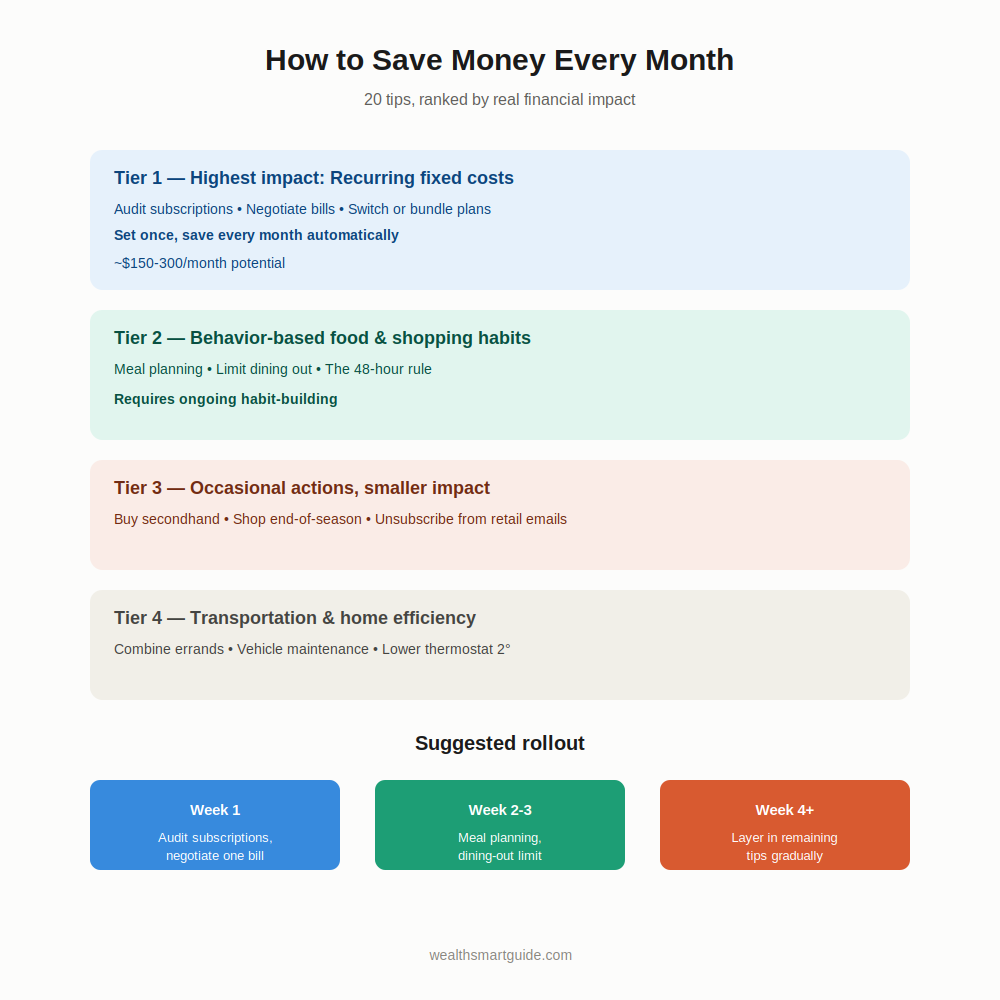
The Highest-Impact Category: Recurring Fixed Costs
These matter most because, unlike a single grocery trip, a saved dollar here repeats automatically every single month without requiring ongoing willpower or decision-making.
Auditing subscriptions: the reason this ranks so high isn’t the individual subscription cost, but the invisibility effect — small recurring charges ($10-15 each) are easy to forget entirely, and three or four forgotten subscriptions can silently consume $40-60 monthly, exactly the kind of small recurring leak discussed in the 50/30/20 budgeting guide as the category people most consistently underestimate.
Negotiating bills (internet, insurance, phone): this works far more often than most people expect because providers typically have retention-specific discounts not advertised publicly, offered specifically to customers who call and mention considering a competitor. A single 10-minute call resulting in a $20 monthly reduction produces $240 annually for effectively zero ongoing effort afterward — among the best time-to-savings ratios on this entire list. This negotiation strategy is a commonly recommended tactic by consumer finance experts.
Switching to a cheaper phone plan or bundling services: these are “set once, save forever” changes — the research and switching effort happens a single time, but the monthly savings continue indefinitely without requiring any repeated decision or willpower, unlike behavior-based savings tips that must be actively maintained every day.
The Second Tier: Behavior-Based Food and Shopping Habits
These require ongoing effort to sustain, but the savings can be substantial once the habit is established.
Meal planning and grocery lists: the actual mechanism here is reducing decision fatigue at the point of purchase. Shopping without a plan means every aisle presents a fresh purchasing decision, and decision fatigue specifically increases impulse buying — a documented behavioral pattern, not just a simplistic warning. A list converts many small in-store decisions into a single decision made in advance, at home, without the sensory triggers (smells, displays, hunger) that drive impulse purchases in-store.
Limiting dining out: the multiplier here (3-5x the cost of cooking equivalent meals at home) means this single habit often has more monthly financial impact than several smaller tips combined. Reducing dining out from 5 times weekly to twice weekly, at a rough $15 per-meal difference, saves roughly $180 monthly — comparable to several other tips on this list combined.
The 48-hour rule for non-essential purchases: this specifically works because of a well-documented psychological pattern — the emotional urgency driving an impulse purchase decays significantly within just a day or two, while the actual usefulness of the item typically doesn’t change at all. Waiting doesn’t mean permanently forgoing purchases; it means separating emotional urgency from genuine need, allowing the second (rational) evaluation to actually influence the decision.
The Third Tier: One-Time or Occasional Actions With Real But Smaller Impact
Buying secondhand and shopping end-of-season: these produce genuine savings, but only on purchases you were already planning to make — unlike bill negotiation or subscription audits, these tips don’t create ongoing automatic savings; they simply reduce the cost of purchases that would have happened anyway.
Unsubscribing from retail email lists: the underlying mechanism is worth stating explicitly — marketing emails exist specifically to convert planned non-purchases into unplanned ones by creating a sense of limited-time urgency. Removing this stimulus removes a consistent source of impulse-purchase triggers, working as prevention rather than willpower-based resistance at the moment of temptation.
The Fourth Tier: Transportation and Home Efficiency
Combining errands and considering carpooling or public transit: the savings here accumulate gradually rather than dramatically, but compound similarly to the small recurring subscription costs discussed above — a few dollars in fuel saved per week adds up over a full year into a meaningful total, even if any single trip’s savings feel negligible.
Vehicle maintenance and fixing leaks immediately: these work through a specific mechanism worth understanding — small preventive costs now avoid dramatically larger reactive costs later. A dripping faucet wastes water continuously and invisibly, adding a small but real amount to monthly water bills that compounds over a full year; a neglected vehicle maintenance item often becomes a far more expensive repair once ignored long enough.
Lowering your thermostat by 2 degrees: a modest, easy behavioral change with a genuine, quantifiable payoff (roughly a 5-10% reduction in that specific bill) — small individually, but essentially free to implement and requiring no ongoing decision-making once set.
How to Save Money Every Month: Prioritizing the 20 Tips the Right Way
If you’re serious about how to save money every month, trying to implement all 20 tips simultaneously typically leads to the same abandonment problem discussed in budgeting contexts — attempting too much change at once tends to collapse within weeks. A more sustainable sequence:
Week 1: Audit subscriptions and negotiate at least one recurring bill (internet, insurance, or phone) — these produce the largest “set once, save forever” impact for the least ongoing effort.
Week 2-3: Implement meal planning and grocery lists, and set a specific dining-out limit — these require building a new habit, so give them dedicated focus before adding more changes.
Week 4 onward: Layer in the remaining tips gradually (48-hour rule, cashback apps, transportation adjustments) as the earlier habits become automatic and no longer require active mental effort.
How to Save Money Every Month: The Honest Range of What’s Realistic
Implementing the highest-impact tips alone (subscription audit, bill negotiation, reduced dining out) commonly produces $150-300 in monthly savings for a typical household, even before touching the remaining, smaller-impact tips. Adding the full list of 20 tips can realistically push total monthly savings toward $200-500 depending on your specific starting spending patterns — the wide range reflects how much impact depends on which categories were previously unmanaged versus already tightly controlled.
Where this saved money should go, connecting back to earlier priorities: as covered in the emergency fund and debt payoff guides, these newly freed monthly dollars have a clear priority order — first toward completing an emergency fund if not yet fully funded, then toward high-interest debt payoff, and only after both of those toward additional investing contributions. Redirecting savings without this sequence in mind often means money saved in one area quietly disappears into unplanned discretionary spending instead of building genuine financial progress.
Conclusion: How to Save Money Every Month, the Smart Way
If you want to know how to save money every month without wasting effort, remember this: not all 20 savings tips deserve equal attention — recurring fixed-cost changes (subscription audits, bill negotiation) provide the highest return for the least ongoing effort, because the saved dollars repeat automatically every month without requiring daily willpower. Behavior-based habits (meal planning, the 48-hour purchase rule) provide substantial additional savings but require deliberate habit-building over several weeks. Start with the highest-impact, lowest-effort category first, and direct the resulting savings toward your highest financial priority — emergency fund, then debt, then investing — rather than letting it drift back into unplanned spending.